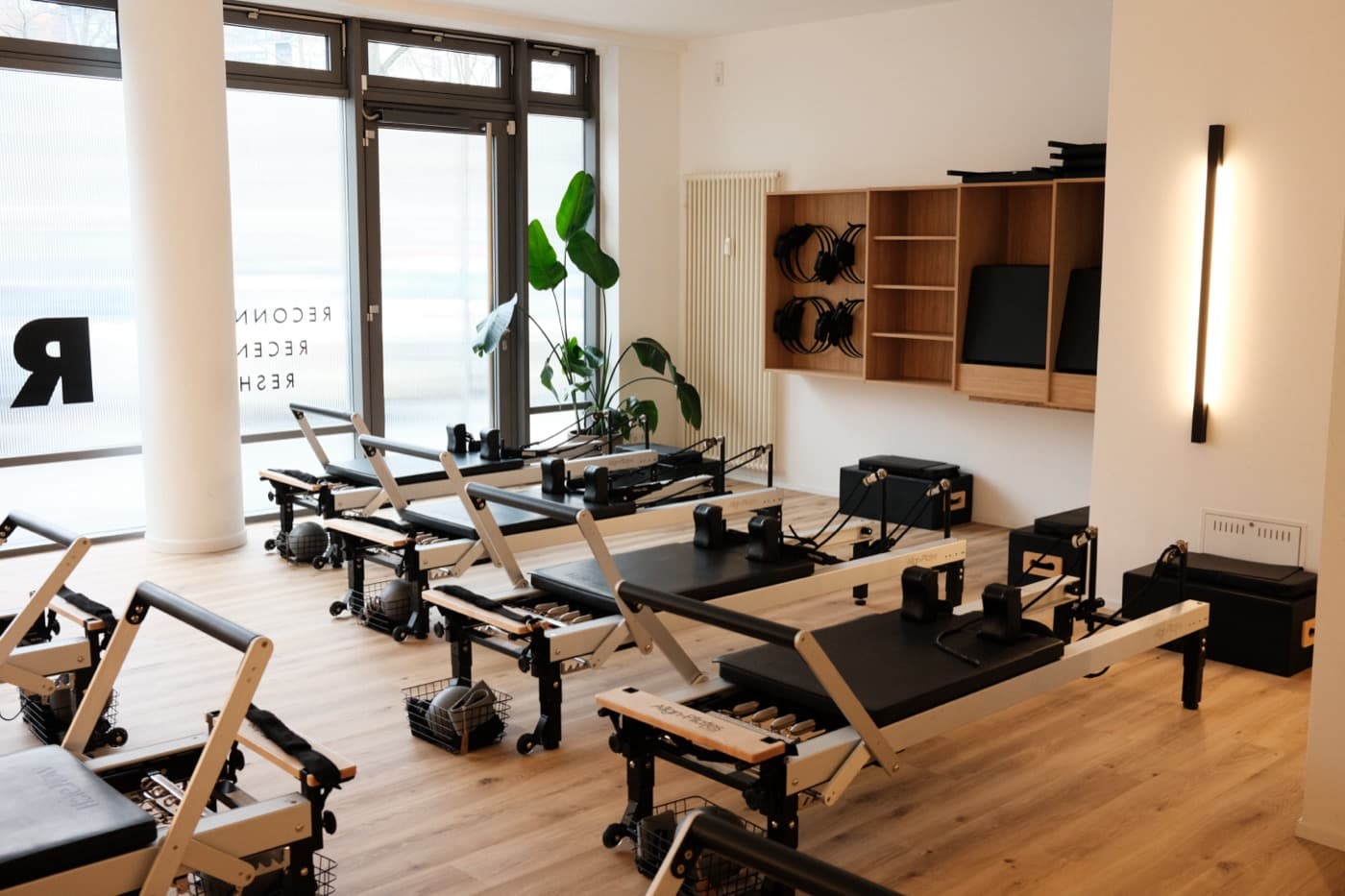
The jump board is the piece of kit most instructors own and fewest teach well.
It goes on the end of the reformer, everyone gets excited, and then the class turns into fifteen minutes of loud, uncontrolled bouncing with a playlist over the top. Nobody gets hurt, exactly. But nobody gets much either.
It does not have to go like that. The jump board is genuinely one of the best tools you have — it is the only way to get real cardio into a reformer class without asking anyone to stand up and jog.
Short version: Teach the landing before you teach the jumping. Start most groups on one red plus one blue spring. Keep the segment to fifteen to twenty minutes for regulars, five to eight the first time. Intensity comes from tempo and springs, never from height.
What the jump board actually does
Jumping lying down is not just jumping made easier. It is a different exercise.
Because your client is supine, the spine is supported and gravity is not driving the landing. The load that would normally travel up through the ankles, knees and hips on every landing is largely gone. What is left is the muscular work of pushing away and, more importantly, the control needed to come back.
That is why the jump board suits people who find impact work painful — sore knees, dodgy ankles, anyone who has been told to avoid running. They can raise their heart rate without the pounding.
It also means you can actually see what is happening. In an upright jumping class you are watching twelve people from behind and hoping. Here everyone is lying in front of you in a straight line. Alignment problems are obvious.
"The jump board is not the easy version of jumping. It is the version you can supervise."
Spring settings, by what you want
Springs on the jump board are not a difficulty dial. They change what the exercise is.
The spring controls how fast the carriage returns your client to the board. More spring means a faster, more supported rebound. Less spring means a slower return and much more work to control it.
| Setting | Feels like | Use it for |
|---|---|---|
| 1 red + 1 blue | Even, controlled rebound | Default for groups, all foot patterns |
| 2 red or more | Running uphill | Power, athletic clients, shorter bursts |
| 1 red | Lighter, quicker | Longer endurance sets, faster tempo |
| 1 blue only | Running on the moon | Advanced pelvic control — hardest, not easiest |
That last row is the one people get wrong. Taking springs off does not make the jump board gentler. It removes the support that was holding the pelvis steady, so the client has to produce that stability themselves. Save it for people who have earned it.
If the general logic of springs as support versus resistance is still fuzzy, the spring settings guide for group classes covers it properly.
Teach the landing first
This is the whole thing. If you only change one part of how you teach jump board, change this.
Beginners push off hard and crash back. They are treating the board like a wall to hit. What you want is the opposite: a soft, quiet, rolling landing where the foot meets the board toes first, then ball, then heel — the same way a foot meets the ground when you land from a real jump.
Three cues that do the heavy lifting:
- "Land quietly." The simplest and best. A loud class is an uncontrolled class. Volume is honest feedback and everyone can hear their own.
- "Roll through the whole foot." Toes, ball, heel. Heels should actually touch the board, not hover.
- "Pull away from the board, don't push." Slightly counterintuitive, and very effective — it stops clients driving the carriage away in one aggressive shove and keeps the movement connected to the centre.
Spend the first two minutes on this with no tempo and no music. It feels slow. It saves the next fifteen.
A progression that holds up in a group
Do not open with single-leg work. Build in this order, and only move on when the room looks controlled.
- Foot patterns, two legs. Parallel, then small V, then wide second. Slow. This is your assessment — you are watching for knees tracking over toes and a pelvis that stays put.
- Running and prancing. Alternating heels. Coordination goes up, load stays the same.
- Jumping jacks. Legs open and close in the air. First real coordination challenge.
- Single leg. Only for people whose two-legged landings are quiet. This is where knee alignment gets tested and where you will see the most compensation.
- Arms and props. Once the legs are automatic, add hand patterns — first empty-handed, then with light weights of around one kilo.
A first-timer group might spend a whole segment on steps one and two. That is a successful class, not a slow one.
Where it goes in the class
After the warm-up, before your finishing work. Never first, never last.
Not first, because cold hips and unprepared feet land badly. Your client needs footwork and some pelvic work before their body knows where neutral is.
Not last, because you want time to bring the heart rate down and to work on something slow afterwards. Ending a class on peak cardio sends people back to their day still buzzing.
For a sixty-minute class: fifteen minutes of warm-up and footwork, fifteen to twenty on the board, then twenty on the long box, arms and stretch. For a first-time group, cut the board segment to five to eight minutes and expand what comes after.
One practical note: the board goes on and comes off, and that costs time. Set it up during your warm-up if the layout allows, or plan the segment so it happens once — not twice with a break in between.
Who should sit it out
The jump board is low-impact, not no-impact. Be straightforward about who modifies.
- Acute knee, hip or ankle injury. Low impact still means repeated loading.
- Pelvic floor symptoms. Rhythmic loading can provoke them even lying down. Ask, offer a clear alternative, do not make anyone explain themselves in front of the group.
- Later pregnancy. Supine position plus impact — swap it.
- Acute low-back pain. Wait until they can hold neutral through basic footwork.
- Anyone whose landings are still loud. Not a medical reason, just a readiness one. Keep them on two legs.
Have a real alternative ready rather than "just rest" — a footwork variation on the bar at matched tempo keeps someone in the class instead of watching it.
Three mistakes worth avoiding
Letting the music set the tempo. A fast track pulls the whole room into rushing, and landing quality is the first thing to go. Set the tempo with your voice, then let the music sit underneath it.
Chasing height. Nobody needs to launch the carriage. Range should be repeatable for the length of the set. If someone is bottoming out the springs, they are working the equipment, not themselves.
Treating it as a filler. The board is not fifteen minutes of cardio glued onto a Pilates class. It is Pilates. The same rules about pelvis, ribs and breath apply — cue them the way you would anywhere else.
Where to start
Pick your next class with a group you know well. Put the board on for eight minutes after footwork. Teach only parallel, V and running — nothing else.
Cue "land quietly" and mean it. Watch the room. You will learn more about your clients' control in those eight minutes than in a month of mat work.
Then build from there. If you want a theme to hang a whole class on, class themes pairs well with a board segment — cardio slots neatly into most of them.
Want the planning done for you?
Pilates Plans gives you ready-made reformer class plans — one full plan free, more individually or as a bundle.
→ Get the free plan
Frequently Asked Questions
How many springs should I use for jump board?
Start most groups on one red plus one blue — enough rebound to land softly, enough resistance to stay controlled. Two reds or more feels like running uphill and suits power work. A single blue is the hardest for control, not the easiest: less spring means the pelvis has to do the stabilising.
How long should a jump board segment be?
Fifteen to twenty minutes is the usual working range for a regular client, placed after your warm-up and before your finishing work. For a group meeting the jump board for the first time, five to eight minutes of clean foot patterns is plenty — the limiting factor is landing quality, not fitness.
Is jump board actually cardio?
Yes, but it is low-impact cardio. Jumping while lying down removes most of the joint loading of upright jumping, so heart rate rises without the landing forces. That makes it useful for clients who find running or step work painful, and it means intensity comes from tempo and spring load rather than height.
Who should not do jump board work?
Skip or heavily modify it for acute knee, hip or ankle injury, uncontrolled pelvic floor symptoms, later pregnancy, acute low-back pain, and anyone who cannot yet keep a neutral pelvis through basic footwork. If someone cannot land quietly on two feet, they are not ready for single-leg work.