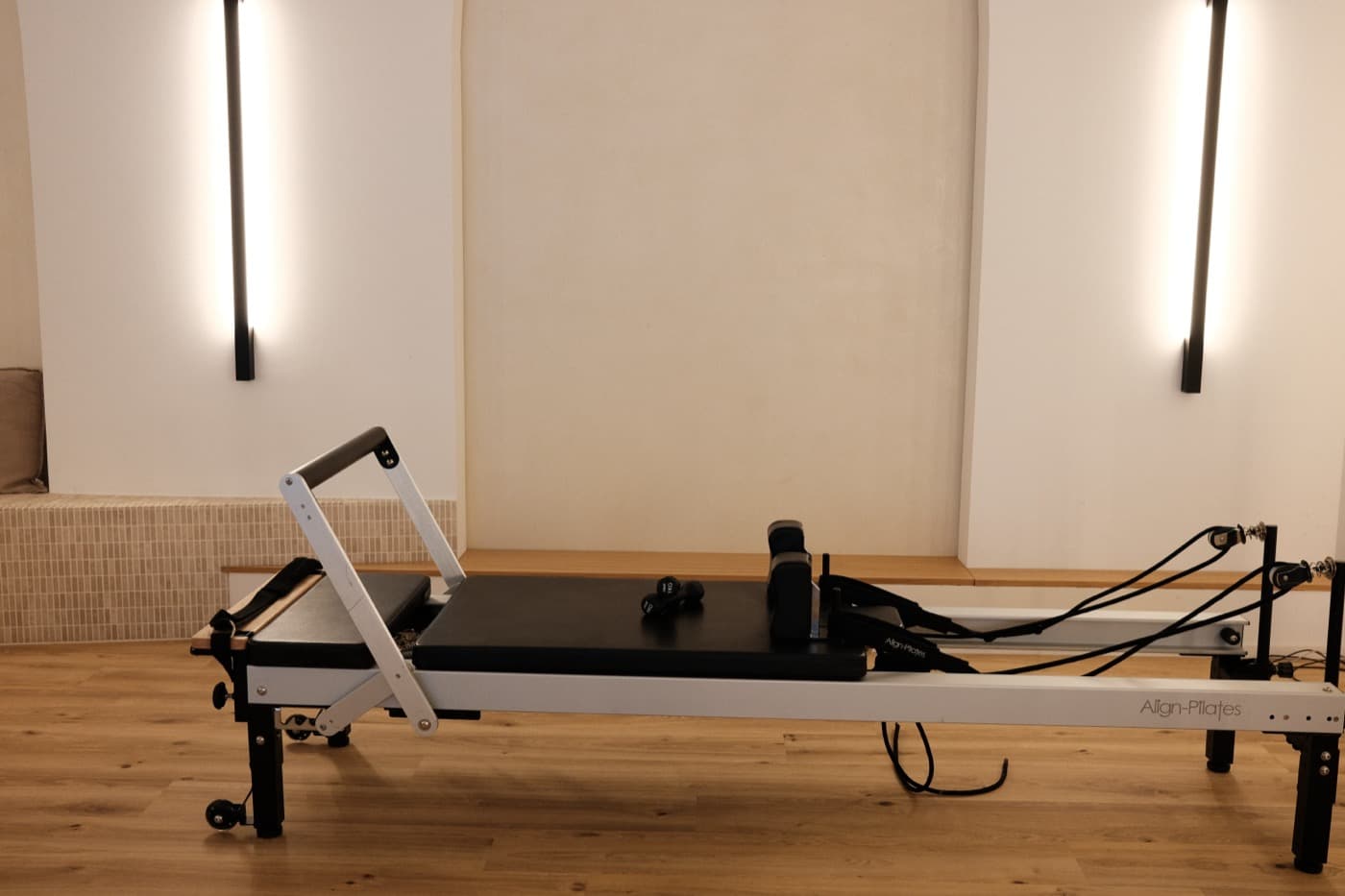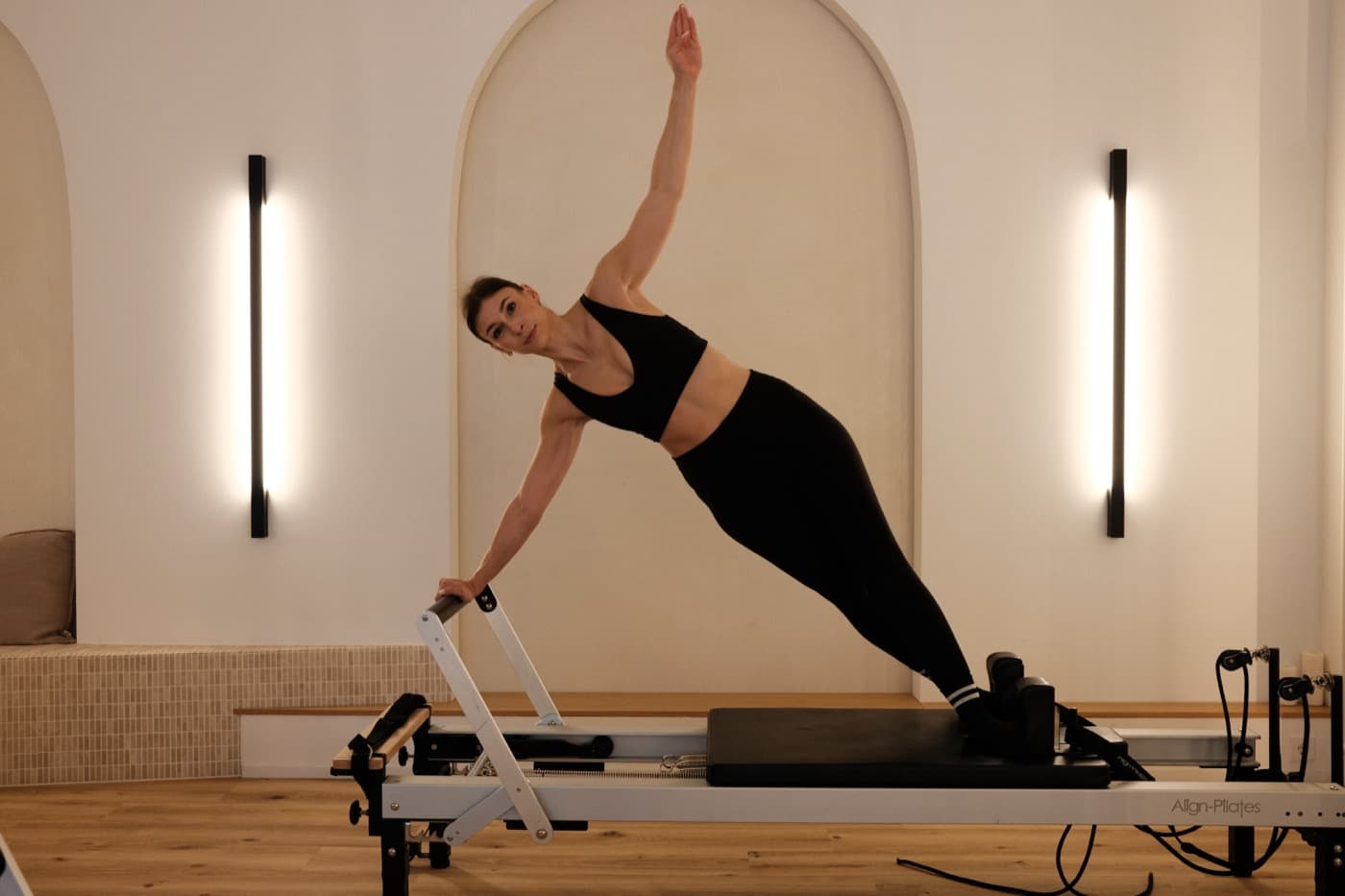
Nine people know the sequence cold. One has never sat on a reformer and doesn't know the carriage rolls.
That's not a rare Tuesday, that's every Tuesday. And it's one of the more honest stress tests your teaching gets: you can't slow the class down for nine people, and you can't leave one person alone on a machine she can't read yet.
Short version: Handle the essentials in the five minutes before class, standing at the machine. Place her in the second row, on your walking path. Teach the same class you planned, but keep an easier option ready for three or four exercises. And don't say anything to the group about the new person.
The Five Minutes Before Class
Ask her to come a few minutes early. It's the only prep that actually matters — and it saves you ten minutes once class starts.
Walk her to a machine and show four things, in this order:
- The carriage rolls. Let her push it with her hand once. Anyone who knows it moves won't flinch on the first push-off.
- The springs create the resistance. Hook one on and off so she hears the sound and sees where the hooks sit.
- Footbar and headrest. Both adjustable, both work the same way. Show her how — she'll need it mid-class.
- Straps and loops. Where they hang, how you get your feet in and out.
Then one single rule, not five: hands off the spring hooks, and don't let the carriage slam into the stopper. That's as much safety information as anyone can hold onto standing still. The rest comes with movement.
Finish by asking about any injuries or discomfort — quietly, one on one. That's the actual point of these five minutes. In front of the group, almost nobody speaks up.
Why Does Where She Lies Matter So Much?
Placement in the room is your strongest lever, and it costs you nothing.
Second row, not the front. Up front, she has nobody to watch and copy. New students glance sideways to learn — that's not a lack of focus, it's the fastest way to pick things up.
Next to someone experienced, ideally someone calm and clean in their form. That person becomes a second instructor without saying a word.
On your walking path. You move through a set route every class. Put her where that route already passes, and you don't need a detour.
The Class Stays the Class
The most common reflex is to dial the whole class down. Don't.
Nine people showed up to work. If the class suddenly gets noticeably easier, they'll feel it right away — and so will the new student. Nobody wins there.
Instead: teach the class you already planned, and have an easier version ready for three or four exercises. Not all of them. Just the ones where new students typically get stuck:
- Anything in the straps, lying down. Coordinating arms and carriage together feels foreign at first. Easier version: shorter range, more spring.
- Kneeling or standing on the carriage. Cut it for the first class, or offer a mat version instead.
- Anything with rotation under load. Save it until the pelvis stays quiet in plain footwork.
- The transition to the box. The exercise itself isn't the problem — getting on and off in the group's rhythm is.
The thinking behind this shows up again in the article on mixed-level classes — layering into regression, base and progression is the exact same tool, just aimed at one person instead of a whole spread of levels.
Should You Say Anything to the Group?
"We have someone new today, be patient with her" is well-meant and uncomfortable for everyone involved.
Nobody wants to be introduced as the beginner in front of ten people. And the group doesn't need the information — they can see it anyway.
Say something that applies to everyone instead: "every exercise today has a smaller variation, take whichever one feels right." That gives permission without putting anyone on display — and your regulars having an off day will quietly use it too.
"An instruction meant for one person makes that person visible. An instruction meant for everyone helps her just as much — and three other people besides."
How Many Check-Ins Does She Actually Need?
The second common reflex: hovering the entire time. That makes the new student nervous and leaves the rest of the room unsupervised.
Plan two deliberate check-ins instead.
The first after footwork. By then you've seen how she's handling springs and carriage, and you can fix one single thing. One, not three.
The second in the back half of class, once focus starts to fade and compensations creep in. That's the moment a correction actually changes something.
In between, a glance is enough. And if a cue is really meant for her, say it to the whole room. "Heels stay heavy" helps her — and nobody in the room knows it was aimed at one person.
The Last Two Minutes
Stay by the door after class and talk to her briefly. Not long, two sentences do it.
Ask how it felt, and tell her one specific thing that went well. Not "great job" — something like "your footwork was steady from the very first rep." Specific praise sticks, general praise doesn't.
Then tell her what will feel easier next time. Anyone who knows the confusion is normal and fades comes back. That's the entire point of this exercise: a trial class turns into a regular, or it doesn't — and that gets decided in these two minutes almost as much as in the sixty before them.
What If There's More Than One?
With two or three new people in one group, the math shifts. That's no longer individual support — it's a different class.
In that case: pitch the theme simpler, budget more time for transitions, and cut anything that needs heavy explanation. A shorter class with clean transitions beats one where you're constantly catching people up. For what that structure looks like, see the article on planning a reformer class.
And if the entire group is brand new, you need a class plan of its own. A fully written-out one for 45 minutes is in the reformer class plan for beginners.
Want the planning done for you?
Pilates Plans gives you ready-made reformer class plans — one full plan free, more individually or as a bundle.
→ Get the free plan
Frequently Asked Questions
How do I introduce someone to the reformer who's never been on one?
Five minutes before class, standing at the machine: carriage, springs, footbar, straps. Then one single rule — hands off the spring hooks, don't let the carriage slam. That's all the prep anyone needs standing still. Everything else clicks once they're moving.
Where do I place a new student in the room?
Second row, facing someone experienced, on your walking path. Not the front row — from there she has no one to copy. Not the back either, or you can't reach her fast enough.
Should I redesign the whole class for one new person?
No. Teach the same class and keep an easier option ready for three or four exercises. Slow the whole group down because one person is new, and everyone notices immediately — and it doesn't actually help the new student either.
What do I tell the group when someone new joins?
Nothing special, ideally. Nobody wants to be introduced as the beginner in front of ten people. Instead, mention generally that every exercise has a smaller variation today — that applies to everyone and singles out no one.