You say "and now breathe into your ribs." In front of you, eight people hike their shoulders and suck in their bellies. Two hold their breath completely. One looks at you like you just explained physics.
That's not an attention problem. The instruction describes something you can't see and can barely feel — and then everyone's supposed to get it at the same time, while already doing an exercise.
Short version: Breathing isn't learned by explaining it, it's learned by feeling it. Give your group a point of contact (hands on the ribs), a clear rhythm (exhale on effort), and no more than one breathing cue per exercise. Everything else happens on its own — over weeks, not in one class.
Why Doesn't "Breathe Into Your Ribs" Land?
The instruction has two problems.
First, it's an internal cue. It points attention at something inside the body that most people can't feel. Cues that point to an external reference point almost always land better — you can read more on why in the article on cues that don't land.
Second, it comes too late. If your group is already deep into footwork, moving the carriage, their attention is on legs, springs, and tempo. There's no room left for a new concept.
The good news: you don't need a better sentence. You need a different moment and a point of contact.
What Jobs Does Breathing Actually Do in Your Class?
Before you cue breathing, decide what it's for. There are three reasons — and each needs a different cue.
1. Setting the Rhythm
Breath is your metronome. "Exhale as you press away, inhale as you return" sorts a whole group into two repetitions — without you having to count.
This is the most common and most underrated function. A group breathing together moves together. And suddenly the class looks calm.
2. Regulating Tension
Exhaling lowers tone. Someone who's gripping doesn't need a correction cue — they need a breath cue: "Let your shoulders get heavier as you exhale."
This works for almost anything that looks like strain on someone's face — hiked shoulders, clenched jaw, held breath during leg work.
3. Supporting the Movement
Some movements simply get easier with the right breath. Rotation needs an exhale to reach its end range. Spinal mobilization flows better with breath than without — see the concept of mobility and stability for more.
"If you can't say in one sentence what a breath cue is for right now, drop it. The class gets better, not worse."
Lateral Breathing — How to Make It Felt
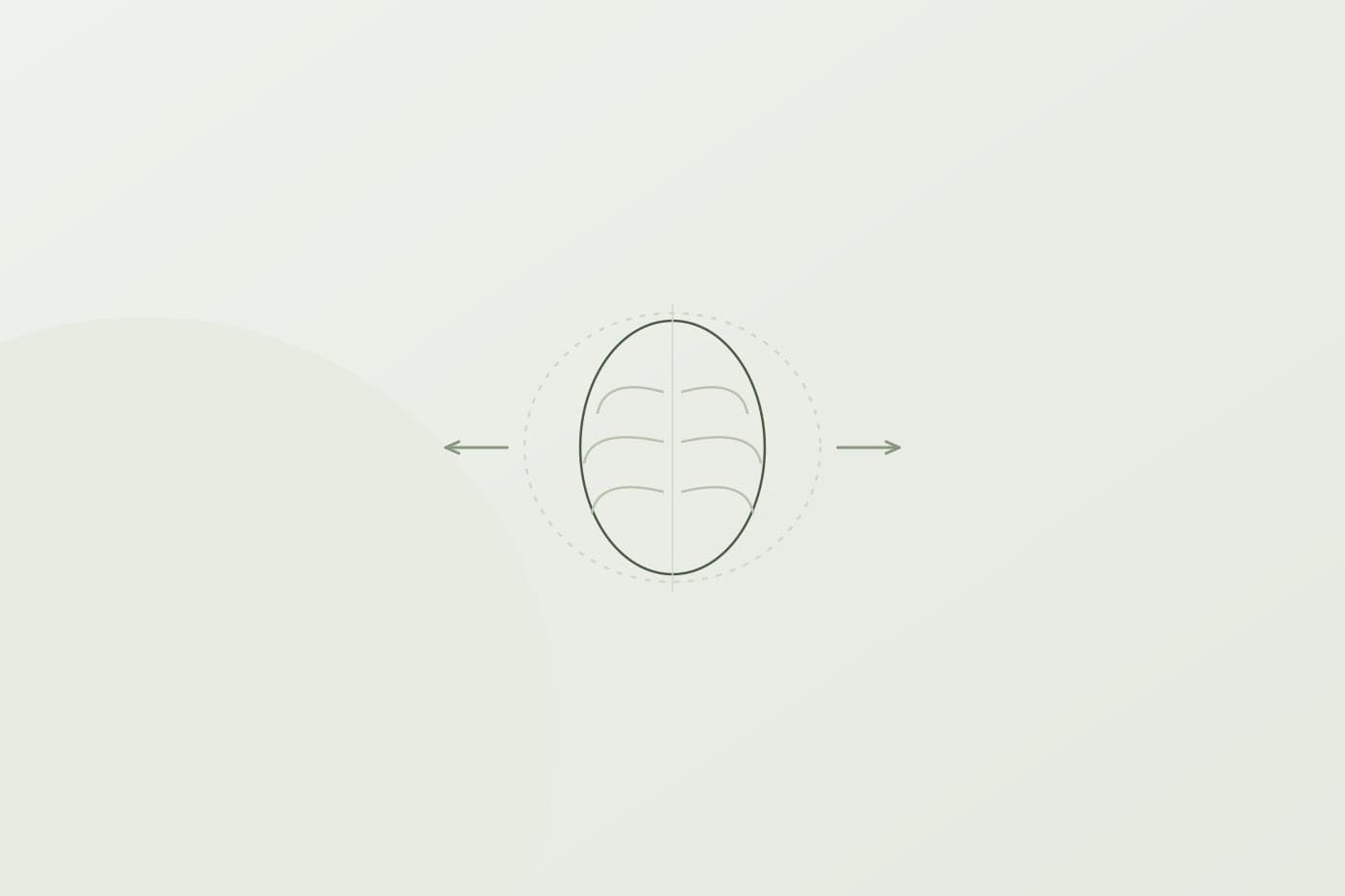
Lateral breathing means the air moves into the sides and back of the ribcage instead of pushing the belly forward. The ribs move like a bellows. The belly stays quiet, core engagement stays intact.
This isn't just training folklore. In an EMG study with 19 untrained women (Journal of Bodywork and Movement Therapies, 2015), transverse and internal oblique abdominal activity was higher during Pilates breathing than during normal breathing. A follow-up study with 28 women (Journal of Physical Therapy Science, 2017) found measurably more activity across all the core muscles examined after breath training. Small samples, healthy participants — but they point in the same direction as what you already see in class.
Explaining doesn't help much. These four approaches do:
- Their own hands on the ribs. Both palms on the sides of the lower ribcage, fingers pointing forward. "Breathe so your hands move outward." The strongest starting point, because everyone gets instant feedback.
- A band around the ribcage. A resistance band loosely wrapped around the lower ribs, ends crossed and held lightly in front. The breath pushes against something they can feel. Works in a group too, if you set it up beforehand.
- Lying face down. On the long box or on the mat, the breath almost automatically moves into the back — the belly simply can't push forward.
- Cueing the back. "Breathe into the spot where your ribs touch the mat." An external cue with a contact surface — the best sentence I know for breathing into the back.
And one more thing: say how to breathe, too. In through the nose, out through slightly parted lips. It's in every training manual — but rarely said out loud in class.
Exhale on Effort — the Rule and Its Limits
The basic rule: exhale on effort, inhale on the return. For bridging, exhale as you roll up. For footwork, exhale as you press away. For roll-up, exhale as you curl up.
This rule covers ninety percent of your group class, and it's easy to remember.
Now, the honest part: in the classical method, it's deliberately reversed for a handful of exercises — for instance, when the inhale is meant to support the lift into an upright position. That's technically correct, and still rarely useful in a group class.
My recommendation for classes: announce one rule, stick with it, and only mention exceptions where you genuinely need to. Someone taught three breathing patterns in one class will remember none of them.
Eight Breathing Cues That Actually Work
On the left: what a lot of people say. On the right: what lands better.
| Situation | What you say | What it's for |
|---|---|---|
| Warm-up, group settling in | "Push your hands out to the side as you inhale" | Making lateral breathing felt |
| Footwork, tempo falling apart | "Out as you press" | Rhythm for the whole group |
| Shoulders creeping up | "Let them get an inch heavier as you exhale" | Lowering tone |
| Someone's holding their breath | "Stay audible" | Checkable, without pressure |
| Rotation, not reaching full range | "Exhale and rotate two more inches" | Supporting the movement |
| Closing | "Notice if your breath feels different than it did at the start" | Awareness instead of instruction |
- Instead of "breathe into your ribs" → say "push your hands out to the side as you inhale."
- Instead of "take a deep breath" → say "let the breath get wide, not high."
- Instead of "exhale" → say "breathe out like you're blowing out a candle across the room" (when you want more core engagement).
- Instead of "relax your shoulders" → say "let them get an inch heavier as you exhale."
- Instead of "breathe into your back" → say "breathe into the spot where your ribs touch the mat."
- Instead of "don't hold your breath" → say "stay audible" (works instantly because it's checkable).
- Instead of "breathe at your own pace" → say "exhale as you press away — I'll count the first three with you."
- Instead of "breathe mindfully" → say nothing and just breathe audibly yourself. Groups sync up with each other surprisingly reliably.
That last one is the most powerful in this whole article. Your own breathing is a cue — and the only one that costs you nothing. For how to build your teaching language overall, see the guide on learning to cue.
Where Does Breathing Belong in the Flow of Your Class?
Not evenly spread throughout. Three moments are enough.
At the start: once, properly. The first two to three minutes are the only moment everyone has full attention to spare for breath. This is where hands-on-ribs and three to five calm breaths belong — and nothing more. For how to build these opening minutes overall, see the article on warm-up exercises.
In the main section: as rhythm, not as a topic. Here you only cue breath alongside the movement itself. "Out as you press." Two words. No explanation.
At the end: as awareness. In the final minutes, breathing becomes content again — but this time without instruction. "Notice if your breath feels different than it did at the start." This is the moment people actually notice the difference.
In mixed-level groups, one more thing applies: breath guidance is optional. Anyone struggling with it gets offered it once, then left alone — more on this in the article on mixed-level classes.
What Mistakes Does Almost Everyone Make?
Too much at once. Breath direction, breath rhythm, and breath depth in one exercise — that's three times more information than actually lands. One aspect per exercise.
Cueing breath after the exercise has already started. The carriage is moving, the tempo is set, and now a new instruction shows up. Cue the breath before the first rep, or not at all.
Prioritizing breath over movement. If someone holds their breath just to follow your breathing instruction, you haven't gained anything. In that case: "Breathe however feels right — just don't hold it." And one fewer cue next time.
Breathing is only one part of cueing overall — for the full picture, see the cueing guide.
And if you feel like you run out of words fast when it comes to breathing: that's normal, and it's not a knowledge gap. It's almost always because breathing gets explained in training, but rarely practiced. Try setting yourself one deliberate breath cue per class for a week — after five classes, you'll have your own language for it.
Want class plans that already have the breathing built in?
Pilates Plans gives you ready-made reformer class plans — with spring settings, cues, and videos for every exercise.
→ Get the free plan
Frequently Asked Questions
How do you breathe correctly in Pilates?
In through the nose, out through slightly parted lips — and into the sides of the ribcage, not the belly. The ribs widen sideways and backward, the belly stays quiet, the shoulders stay down. This is called lateral or rib-cage breathing. It keeps your core engaged while still giving you plenty of air.
When do you inhale and exhale in Pilates?
The basic rule: exhale on effort, inhale on the return. For bridging, that means exhale as you roll up, inhale as you lower down. The rule is a starting point, not a law — some exercises in the classical method deliberately reverse it. For group classes: announce one clear rule and stick with it, rather than explaining three exceptions.
What is lateral breathing in Pilates?
Lateral breathing means the air moves into the sides and back of the ribcage instead of pushing the belly forward. The ribs move outward like a bellows. The advantage in Pilates: the abdominal muscles can hold their engagement while the breath still stays deep. That's why it's taught in nearly every training program.
What do I do when participants can't get the breathing right?
Let them just breathe naturally first. Someone holding their breath to follow a breathing instruction has gained less than someone breathing freely and doing the exercise cleanly. Say "breathe however feels right — just don't hold it" and bring the breath cue back later in the same class. Breathing is a topic for months, not for one session.